


Gemstones are available in different varieties, colors, sizes, and for varied purposes. Let us consider Blue gemstones in particular, which possess exquisite hues reminiscent of the vast ocean and a clear sky and are prized for their beauty, rarity, and mystical allure. These gemstones are truly a world of meaning, history, and fascinating variety. In this blog, we will explore blue gemstones by learning their names, composition, significance, properties, and cautions (if any). Let us explore unique stories and magical properties behind each precious and semi-precious blue crystal.

Precious & Semi-Precious Blue Gemstones
Let us determine the blue stones' names with pictures and relevant information:
Blue Sapphire
Blue Sapphire is one of the most valued blue gems, known for its astrological influence and deep color. This variety of corundum owes its intriguing blues, from velvety royal to cornflower, primarily to trace amounts of iron and titanium.
The Neelam, or Blue Sapphire stones, are found mainly in historic mines in Kashmir, Sri Lanka, and Madagascar. It is made with aluminium oxide (corundum), iron, and traces of titanium. It has a hardness of 9 on the Mohs scale. The properties of Blue Sapphire include brilliance, loyalty, and discipline, and it also protects one from harm while enriching mental clarity and spiritual growth.
In astrology, this blue gem is associated with Saturn and known to fetch fortune, wisdom, and spiritual attainment. But ensure you wear it after expert advice, as it may not be suitable for everyone. You may reach experts now through a free chat with an astrologer.
Lapis Lazuli
Lapis Lazuli is a blue semi-precious stone name that has been admired for thousands of years in ancient Egypt and Mesopotamia, particularly. Lapis Lazuli is made up of minerals such as pyrite, lazurite, and calcite that present marks of gold (pyrite) and white (calcite). Its color ranges from intense, royal to violet-blue, and can even be mottled with white or gold.
Lapis Lazuli is a blue crystal found in the best quality from Afghanistan, with key sources in Chile and Russia. This gemstone has been historically used as jewelry, amulets, and a basis for treasured ultramarine paint in Renaissance art. Spiritually, the meaning of this blue crystal is instincts, wisdom, and spiritual enlightenment. Wearing this stone can shield against adverse energies and stimulate the third eye chakra.
Know About: Benefits Of Wearing a Red Coral Stone
Blue Topaz
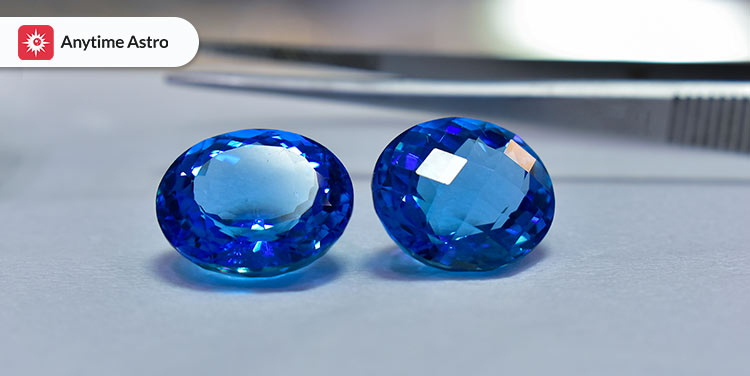
Another blue gemstone is the Blue Topaz, known for its transparent, bright blue shades ranging from pale sky blue to deep London Blue. The most commercial blue topaz is made by treating colorless topaz with irradiation. The Blue Topaz is composed of aluminum fluorosilicate with a hardness of 8.
The Blue Topaz is the birthstone of those born in December and is associated with peace, communication, and manifestation. This blue gem is used for clarity and durability in rings, pendants, and other pieces of jewelry. Wearing it helps bring clearness of thought, emotional harmony, and success in communication.
Aquamarine
Named after the color of the ocean, aquamarine is a tranquil blue-green type of beryl, associated closely with emeralds. This gemstone ranges from light greenish-blue to deep sea blue and can show high clarity. It belongs to the beryl mineral family and has a hardness of 7.5 to 8. This blue gemstone is found mainly in Brazil, Russia, Madagascar, and Pakistan.
Aquamarine is a 19th anniversary gem and the March birthstone. It represents courage, hope, and everlasting youth. It helps soothe the nerves and enhance relationships.
Tanzanite
The name of this blue stone was not known until the mid-20th century, as it was just then that it was discovered. Tanzanite is one of the most modern and rare blue gems, mined in a remote area of Tanzania. The color of this gemstone is a striking blue-violet and is frequently trichroic as it displays blue, violet, and red based on the angle of light. It belongs to the zoisite category and has a hardness of 6 to 7 on the scale.
Tanzanite is widely used in high-end jewelry and is the birthstone of December. The benefits of using this blue stone are enhanced transformation, higher consciousness, and an optimistic outlook.
Know About: 16 Black Gemstones: Properties, Uses, and Benefits
Labradorite
Labradorite is prized for its unique labradorescence, a rainbowy play of colors, often blue or green, that flickers over a base of gray to black. It belongs to the feldspar group and has a hardness of 6–6.5. You can find it in large quantities in Canada, Madagascar, and Finland.
Believed to boost intuition, protect the aura, and benefit personal growth, labradorite is a collector’s gem esteemed for both its beauty and metaphysical properties.
Blue Aventurine
Blue Aventurine is a gentle, rare member of the aventurine quartz family, depicted by sparkling inclusions such as dumortierite. Its color ranges from soft to vivid bluish tones, often with a shimmering aventurescence, and it ranks around seven on the hardness scale.
Aventurine symbolizes self-discipline, calmness, and clarity, and is associated with balanced emotions and enhanced communication skills.
Blue Diamond
Blue Diamonds are one of the rarest and most prized gems; their intense color is caused by traces of boron within their crystal structure. Colors span from delicate sky blue to deep, vivid tones - the richer the shade, the higher its value. Composed of pure carbon, they hold the top hardness of 10.
The blue diamond is associated with infinity, eternal love, wealth, and success. Iconic gems like the Hope Diamond have secured this blue gemstone a place as symbols of prestige and investment.
Iolite
Known as water sapphire, Iolite is appreciated for its pleochroism, meaning it can shift from blue to violet depending on the viewing angle. It is a gem-quality cordierite with a hardness of 7 to 7.50. It is found mainly in Sri Lanka, Tanzania, India, and Brazil.
Iolite symbolizes clarity, spiritual vision, and guidance, making it a treasured counterpart for inner journeys and an affordable alternative to blue sapphire.
Know About: Best Crystals for Love
Blue Moonstone
Blue Moonstone captivates with its glowing adularescence, a shifting blue sheen enhanced by movement. This feldspar, with a hardness of 6 to 6.50, is typically translucent and cut en cabochon.
It is a June birthstone related to the Moon Goddess traditions and treasured for encouraging intuition, emotional harmony, and balance in relationships. This blue stone serves as a substitute for a pearl in astrology.
Blue Spinel
Blue Spinel is a rising star in the gemstones world, offering an increasingly sought-after pure, vivid blue color. This blue gem is often mistaken for sapphire. It is made of magnesium aluminium oxide and measures eight on the hardness scale. Its color ranges from pastel to cobalt blue.
The best Blue Spinel stones come from Myanmar and Sri Lanka. It represents inner peace, mental clarity, and resilience, and offers a unique and reasonable choice for fine jewelry.
Turquoise
The Turquoise stone has been treasured since ancient times across Egypt, Persia, and the Americas. It is highly priced for its sky-blue to blue-green shade and opaque appeal. Composed of hydrated copper aluminium phosphate, it has a hardness of 5 to 6, usually featuring dark veining known as matrix.
This incredible blue gem is found in Iran, Tibet, and the South-West USA. It is a December birthstone and 11th anniversary gem. Turquoise stone represents protection, eloquence, and spiritual alignment.
Other Blue Gemstones
Here are the names of blue stones with their brief descriptions:
Blue Tourmaline
Blue tourmaline, known as Paraiba or indicolite, retains a vibrant color and is rare. These blue gems denote communication and open-mindedness.
Kyanite
Kyanite is intense sapphire-like blue and is famous for exceptional pleochroism. It symbolizes serenity and is believed to align chakras and pacify the mind.
Blue Apatite
Blue apatite is a rare, transparent to translucent gemstone - having a striking neon and deep-sea blue color. This blue crystal has a vivid energy and affordability, and is known to foster creativity, intellect, and confidence.
Larimar
Larimar is a rare to greenish-blue type of pectolite, featuring unique white and blue marbling reminiscent of the Caribbean Sea. This blue stone is related to stability, communication, and linked to oceanic healing energies.
Blue Fluorite
Blue fluorite retains a vibrant shade with color-changing properties, maybe fluorescence. This blue crystal denotes clarity, orderly thinking, and spiritual growth.
Blue Zircon
Blue zircon is one of the most radiant and vibrant natural blue gems. The meaning of this blue crystal is associated with wisdom, pleasure, and spiritual growth. It is traditionally a December birthstone.
Know About: Most Powerful Gemstones for Government Jobs
Blue Azurite
Azurite is a deep azure-blue copper mineral located near copper deposits, sometimes blended with green malachite. This blue stone is treasured for its color and symbolism, depicted as instincts, clear understanding, and psychic powers.
Hemimorphite
Hemimorphite is a bright blue to blue-green zinc silicate with a striking appearance. It is associated with personal growth, tranquility, and emotional healing.
Rainbow Moonstone
It is a type of labradorite that has a rainbow-like adularescence, a play of blue and other colors on a milky base. It is related to protection, intuition, and emotional balance, and is usually used in amulets.
Blue Chrysocolla
Chrysocolla exhibits a vivid blue to cyan-green color due to its high copper content. Its permeability helps make jewelry using it. This blue stone symbolizes communication, empowerment, and creative inspiration.
Blue Chalcedony
This blue gem is a cryptocrystalline quartz, naturally light blue and sheer with a waxy luster. Chalcedony is associated with balance, goodwill, and feelings of friendship.
Dumortierite
Dumortierite quartz has a deep blue to violet-blue color and is quite robust, making it suitable for many jewelry applications. Wearing this stone is believed to improve discipline, order, and patience.
Blue Jadeite
The blue jadeite is one of the rarest varieties of jade, shaded from gentle to vibrant blue. This blue gemstone is treasured spiritually for wisdom, stability, and protection from adverse impacts.
Know About: Powerful Gemstones for Good Luck You Can Wear
Blue Opal
Blue opal has an alluring pale to intense blue, and is typically translucent and free from the play-of-color noticed in other opals. It has low hardness and improves emotional healing and communication.
Grandidierite
This gemstone is a rare blue-green in color and ranks among the ten rarest gems in the world. Grandidierite is costly and available in a range of transparent to translucent. It facilitates balance, self-expression, and clarity.
Blue Hawk’s Eye
The Blue Hawk or Falcon’s eye is a deep to grayish-blue gemstone with a fibrous form of quartz associated with the Tiger's eye. This blue crystal backs clarity, instinct, and perception.
Benitoite
Benitoite is famous for its bright-blue color and diamond-like flare. It is rare and is associated with transformation, enlightenment, and communication with higher domains.
Lazulite
Lazulite is a deep-sky blue gem acquired from a blue phosphate mineral. It is prized highly for its color and is softer than most gemstones. This blue crystal is known for its serenity, communication, and balanced relationships.
Blue Akoya Pearl
Blue akoya pearls are saltwater pearls denoted by nuanced blue or silver overtones, marveled for their extraordinary luster. These gems represent purity, compassion, and emotional balance.
Know About: Crystals for Protection from Negative Energy
Shattuckite
Shattuckite is an intense blue crystal that is soft, which limits its use in jewelry, but it is highly collectible. This blue crystal is associated with high intuition, spiritual growth, and honest communication.
Blue Smithsonite
Smithsonite is a rare zinc carbonate available in blue-green to turquoise shades, and usually opaque. It signifies tranquility, healing, and stress relief.
Vivianite
Vivianite exhibits blue-green shades that can intensify with exposure to light. It is a prized gem, but cannot be used in jewelry due to its softness. Using it promotes growth, emotional clarity, and inner peace.
Cavansite
Cavansite is a stunningly blue, translucent mineral found in smallish radiating sprays. This blue stone is very soft and valued for mystical calm and instincts.
Sodalite
Sodalite is a profound ultramarine blue stone often having white calcite stripes. This blue gem is not so costly and usually used in beaded jewelry and carvings. Using it can facilitate insights, thoughts, and clear communication.
Blue Agate
Blue agate is a streaked form of chalcedony quartz, known for its delicate, layered pattern of blue and white. This blue gemstone is highly durable and accessible, and denotes peace, harmony, and grounding.

Frequently Asked Questions
Q.1 Which is the most popular blue gemstone?
Ans. The name of the blue gemstone that is popular and valued for its rich color and durability is sapphire.
Q.2 Which is the most expensive blue gemstone?
Ans. Owing to their rarity and extraordinary brilliance, blue diamonds are the most expensive gemstones.
Q.3 What do the blue gemstones represent?
Ans. Blue gemstones often symbolize wisdom, calmness, and loyalty in many cultures.
Q.4 Which blue stones are the most affordable?
Ans. The names of affordable blue crystals are blue quartz, blue apatite, blue agate, and lapis lazuli.
Q.5 What makes blue a rare color in gemstones?
Ans. Blue shades in gemstones are rare in nature, typically resulting from the presence of specific trace elements, such as titanium, iron, copper, or cobalt, during their formation.
Q.6 Can I use blue gemstones in engagement rings?
Ans. Absolutely! Blue stones such as sapphires, aquamarine, spinel, and blue diamonds are ideal choices for engagement rings due to their durability and stunning appearance.
Q.7 How do gemologists assess the quality of blue gemstones?
Ans. The quality of a blue gemstone is assessed by shade, tone, and saturation, as well as clarity and cut.





Leave a Comment