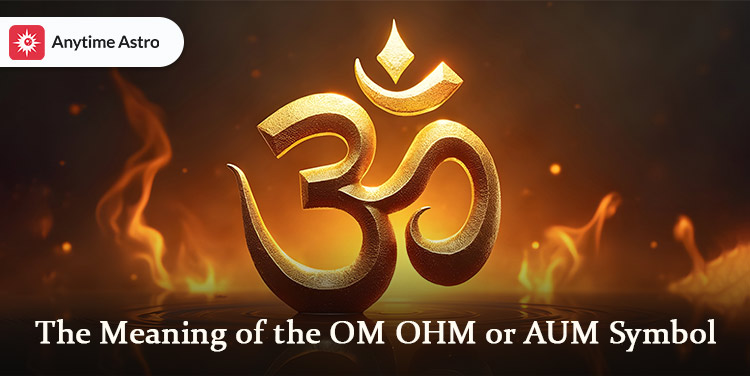


ॐ, or OM—a unique symbol that you've probably seen everywhere, from yoga studios and meditation centers to sound-healing spaces and spiritual books. But beyond its aesthetically pleasing qualities, the ohm symbol meaning carries significant religious significance, particularly within the roots of Hinduism.
So, what exactly does the ohm symbolism mean in Hinduism?
Well! Om, also known as "Ohm" or "Aum," is a unique sound considered to be the voice of the entire universe. It unifies everything and symbolizes everything that exists. Chanting "Om" is like reaching into the very center of reality.
The Aum Om symbol meaning is believed to energize the various energy centers in our bodies, particularly the crown and third eye chakras, through vibrations. These energy centers enable us to sense a connection to something bigger than ourselves. Om is regarded as the sacred syllable—the primordial vibration from which the entire universe began—and is much more than just a sound or visual motif.
Ohm symbolism can be signified as a mantra with cosmic meaning that can be heard in ancient texts, meditations, and rituals.
Want to know more? In this post, we will explore everything about the Ohm spiritual meaning and explain why the Aum Om symbol meaning still has such a strong emotional impact today.

What Does the Om Symbol Represent?
The Om symbol is represented by ॐ in the Sanskrit script (Devanagari). You might be surprised to know that every curve and dot of Om has profound spiritual significance that is connected to human experience and consciousness.
The Mandukya Upanishad states that the Ohm symbol represents the four states of consciousness: deep sleep (sushupti), dreaming (swapna), waking (jagrat), and the fourth state, turiya, or pure bliss.
- The jagrat, or waking state, is represented by the large lower curve, where awareness is directed outward through the senses.
- The dream state (swapna), which reflects the inward-turned consciousness during dreams, is represented by the middle curve.
- The deep sleep state, or sushupati, is represented by the upper curve. This is a state of unconsciousness without any desires or dreams.
- The dot at the top represents the fourth state, turiya, which stands for spiritual enlightenment and pure consciousness.
- The semicircular or crescent shape beneath the dot symbolizes maya, the illusion that prevents one from experiencing ultimate reality.
Ohm Symbol Meaning
The Ohm symbol meaning has major significance in Hinduism. This emblem is a sacred syllable that stands for Brahma, the impersonal Absolute, the source of all manifest existence, and the all-pervasive, all-powerful entity.
This syllable is the symbol of the absolute universe and stands for the entirety of existence as well as the Hindu trinity. The Ohm Hindu meaning is referred to as "the whisper of the universe" and is thought to be the first sound.
A mantra is a word or set of words that is chanted and repeated. It is a sacred sound that is repeated to improve focus and maintain complete silence in mental activity. It’s like you appear to have been the earth, preparing it to receive seeds that will produce beautiful fruits.
What’s more? Well! The Aum Om Ohm meaning is universally regarded as the mantra of mantras. It stands for the original sound that made up the universe.
When we talk about the Om Ohm Aum symbol meaning, it is made up of three syllables (A-U-M), and it represents the past, present, and future, as well as the three states of consciousness: waking, dreaming, and deep sleep. Chanting Om encourages inner peace and spiritual harmony by establishing a connection between the practitioner and divine energy.
The Ohm symbol hindu meaning in Mantras, is regarded as the most potent and revered mantra in Hindu meditation and spiritual practices.
Many religions, including Sikhism, Jainism, and Hinduism, practice it with different interpretations of Ohm symbolism. However, Tibetans pronounce it HUM, Muslims AMIN, and Jews and Christians AMEN.
And you know what? No matter how we interpret the Ohm meaning in Buddhism, the Ohm meaning in Hinduism, or the Ohm meaning in Yoga, it is the same sacred sound that all people share.
The History of the Om symbol
Ohm (or Om) is one of the oldest and most revered sounds in human history, having its origins in the ancient Indian Vedic texts that date back thousands of years.
Om, Ohm, or Aum was first mentioned in the sacred Hindu texts known as the Upanishads or Mandukya Upanishad, which explain various interpretations of the Ohm symbolism. One interpretation of this Hindu document about the Aum Om symbol meaning is that it is immortal and symbolizes all awareness of time, including the past, present, and future, as well as surpassing time itself.
According to our astrologers, these texts are associated with the Vedanta, one of the six major Hindu philosophies, and the oldest Vedantic texts provide a detailed explanation of the complex aspects of the Ohm symbolism mystery. It is believed that the Ohm sign meaning represents the purest foundation of life and all things, eternal language and knowledge, and infiniteness and endlessness.
The Ohm symbol and meaning are also widely used in Buddhist and Jainist mythology, in addition to the Hindu faith.
The Om symbol appears in manuscripts, drawings, and engravings that depict the three religions. Additionally, the Ohm Hindu meaning and its fascinating chant are integral to meditation and yoga.
The Ohm spiritual meaning represents the universe's encompassing cosmic vibration. According to our astrologers, the Ohm symbolism is made up of a dot, a crescent, and a sequence of curves. It is impossible to fully comprehend the Aum Om Ohm meaning by merely looking at its visual representation. You must realize that it comes from the states of consciousness that the Aum Om symbol meaning symbolizes.
Additionally, a lot of people think that Ohm symbolism is the source of the Islamic "Amin" and Christian "Amen." Over the centuries, millions of people could have achieved enlightenment and realized their significant role in the universe if the Om symbol and its chant had such power.
The Ohm symbol and meaning can be interpreted as a timeless sound of harmony, peace, and interconnectedness that still has resonance in many cultures and traditions today.
What Does the Om Symbolism Signify?
For so many people from different faiths, Om holds a special meaning when we interpret the Ohm meaning in Buddhism, the Ohm meaning in Hinduism, or the Ohm meaning in Yoga.
It’s fascinating to see how this ancient symbol connects with everyone in unique ways!
Let’s take a closer look at some of the most common understandings of what Ohm symbolism represents and appreciate the beauty in each interpretation of the Ohm symbol and meaning.
1. The Ohm Symbolism Signifies Ganesha
The Ohm sign meaning is also said to be connected to the Hindu god Ganesha.
This is due to the Om Symbol's shapes being very similar to Ganesha's elephant form. The left curve of the symbol represents his head and belly, while the right curve represents his trunk. Ganesha is the Hindu deity who, before achieving the Absolute State of Bliss, eliminates all barriers and lets go of all material possessions and desires.
For this reason, Ganesha and the meaning of the Ohm symbol are extremely similar. However, if you want to know more about the significance of this sacred symbol and what benefits you can reap when chanting Ohm, you can chat with astrologer for complete guidance.
2. Ohm and Brahma
According to Ohm meaning in Hinduism, the sound of Om originated as a vibration initiated by the consciousness of the Creator God Brahma. This is the reason the world was created. In this way, the Ohm has been associated with the idea that the vibrations produced by reciting Om go back to the vibrations that gave rise to the universe.
According to our astrologers, another name for Ohm is Pranava, which means that your life force is under your control.
3. Ohm and the Holy Trinity
Om is also known as Aum. The rule of three is represented by the three phonetic components of the word "aum," just as the Holy Trinity is the foundation of many different religions.
The Aum Om symbol meaning is a representation of the three realms of Earth, Heaven, and the Underworld, as well as three states of consciousness. In addition, there is the Hindu trinity of Gods: Shiva (the Destroyer), Vishnu (the Sustainer), and Brahma (the Creator).
4. The Ohm Symbolism in Tibetan Buddhism
Om is frequently used at the start of Buddhist dharanis and mantras. The Ohm meaning in Buddhism represents wholeness, perfection, and the infinite, and appears in a number of Tibetan Buddhist mantras.
“Om mani padme hum,” the six-syllable mantra of the compassionate Bodhisattva Avalokiteśvara, is the most famous Buddhist mantra.
According to some scholars, the first word in that mantra (Om) is Aum, which is the entirety of sound, existence, and consciousness, much like the Ohm Hindu meaning.
According to the 14th Dalai Lama, Om is composed of three letters: A, U, and M. These letters represent the practitioner's impure and imperfect body, speech, and thoughts in their daily, unenlightened life. The Ohm meaning Buddhism, also represents an enlightened Buddha's pure body, speech, and mind. Om is a Buddhist symbol that is interpreted very similarly to the Ohm Hindu meaning.
5. Ohm Meaning in Yoga
When you meditate and chant "Om," you create a beautiful vibration within yourself that connects you to the universe. It helps you to think more broadly and feel a sense of unity. And those moments of silence in between each chant? They really stand out and become special moments of reflection!
It allows you to:
- Gradually invite calmness back into your life.
- Improve concentration by increasing mental control. You put an end to the mental fluctuations and daily thoughts.
- Reach a more advanced level of awareness.
The vibrations of the three letters help to activate and cleanse all of our chakras as they resonate from the bottom to the top of our body.
You can repeat this mantra while you meditate or practice yoga, but to achieve resonance with it, you should also focus on its symbol. By visualizing the Aum symbol, you can harmonize with the universal consciousness through a sound vibration.
Frequently Asked Questions
Q.1 What does the Ohm symbolism represent?
Ans. The Ohm is like a special sound that many believe represents the voice of the whole universe! It symbolizes unity and the idea that everything is connected. The Aum Om symbol meaning reminds us that we’re all part of a larger whole, sharing in the wonderful journey of existence together.
Q.2 What are the four states of consciousness represented by OM?
Ans. The Ohm spiritual meaning represents four states of consciousness. The first is waking (jagrat), where we experience daily life. The second is dreaming (swapna), when we explore our imagination while we sleep. The third is deep sleep (sushupti), a calm state where we rest fully. Lastly, there is turiya, the state of pure bliss and spiritual enlightenment, where we feel connected to everything around us.
Q.3 Why is it important to chant the Ohm?
Ans. Chanting OM is a practice that connects us to uplifting energies and brings a sense of peace within. This powerful mantra helps us focus our minds and encourages a delightful harmony in our spirits. When we chant OM, we open ourselves up to a journey of calm and connection, making it a wonderful way to nurture our inner selves.
The Aum Om symbol meaning represents the universe and how everything is interconnected. It represents peace, harmony, and spiritual awakening, making it a valuable component in many cultures and spiritual practices. Whether you're studying its significance in meditation or yoga, or simply admiring its beauty, the OM symbol invites us to connect with ourselves and the world around us.
So, as you reflect on the Ohm symbolism, may it inspire you on your journey towards peace of mind.






Leave a Comment